Best Pocket Fountain Pens of 2026: 6 Pens Compared
Published · 10 min read (estimated)
Six pocket pens compared by length, weight, filling and price — from the $30 Kaweco Sport to the $165 Schon Pocket Six.
A pocket fountain pen is a promise that is easy to make and hard to keep. Shrink a pen until it fits a pocket and you often get something you cannot write a page with. Keep it comfortable and it stops being pocketable. The six pens below are the ones that keep the promise, or come close.
If you want the short answer: the Kaweco Sport is the best first pocket pen, the TWSBI Vac Mini is the best all-rounder under $100, the Liberum Volucris Titanium is the best metal pocket pen, and the Schon Pocket Six is the shortest pen here that still writes like a real pen. The rest of this guide explains when to choose differently.
Prices are US retail as of November 2026.
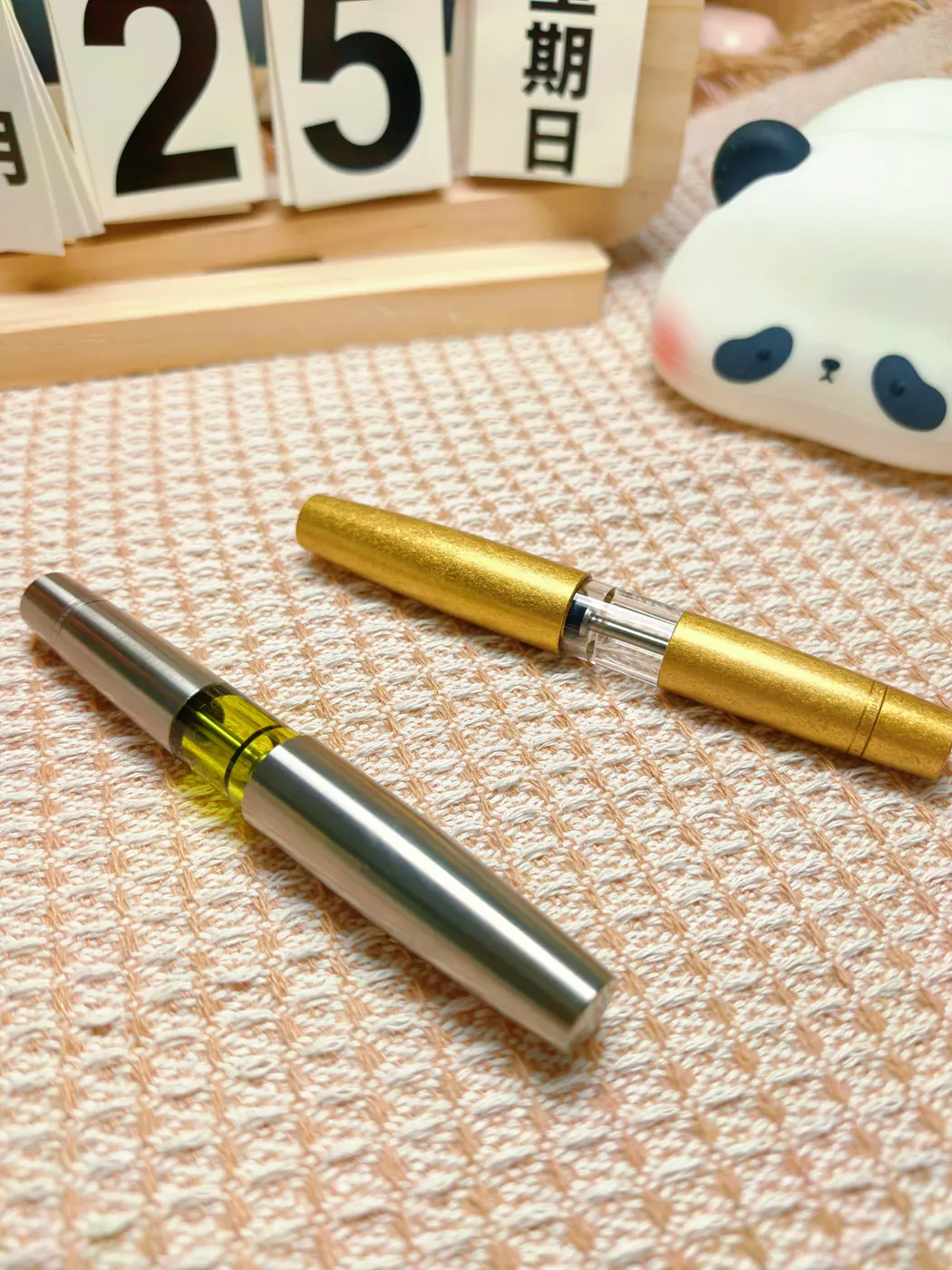
The two Volucris finishes, capped at 120 mm — short enough for a shirt pocket, long enough to write a page with.
First: "pocket" means four different things
Most buying advice treats pocket pens as one category. They are not. Length decides which pocket a pen actually fits, and the difference between 90 mm and 145 mm is the difference between a coin pocket and a jacket.
| Size | Fits | Feels like when writing |
|---|---|---|
| 85–95 mm | Jeans coin pocket, shirt pocket | A small pen. Fine for notes, tiring for pages. |
| 100–110 mm | Shirt pocket, inside jacket pocket | Compact but usable. |
| 115–125 mm | Shirt or jacket pocket, bag | Close to full size in the hand. |
| 140 mm+ | Jacket pocket at best | Not really a pocket pen. |
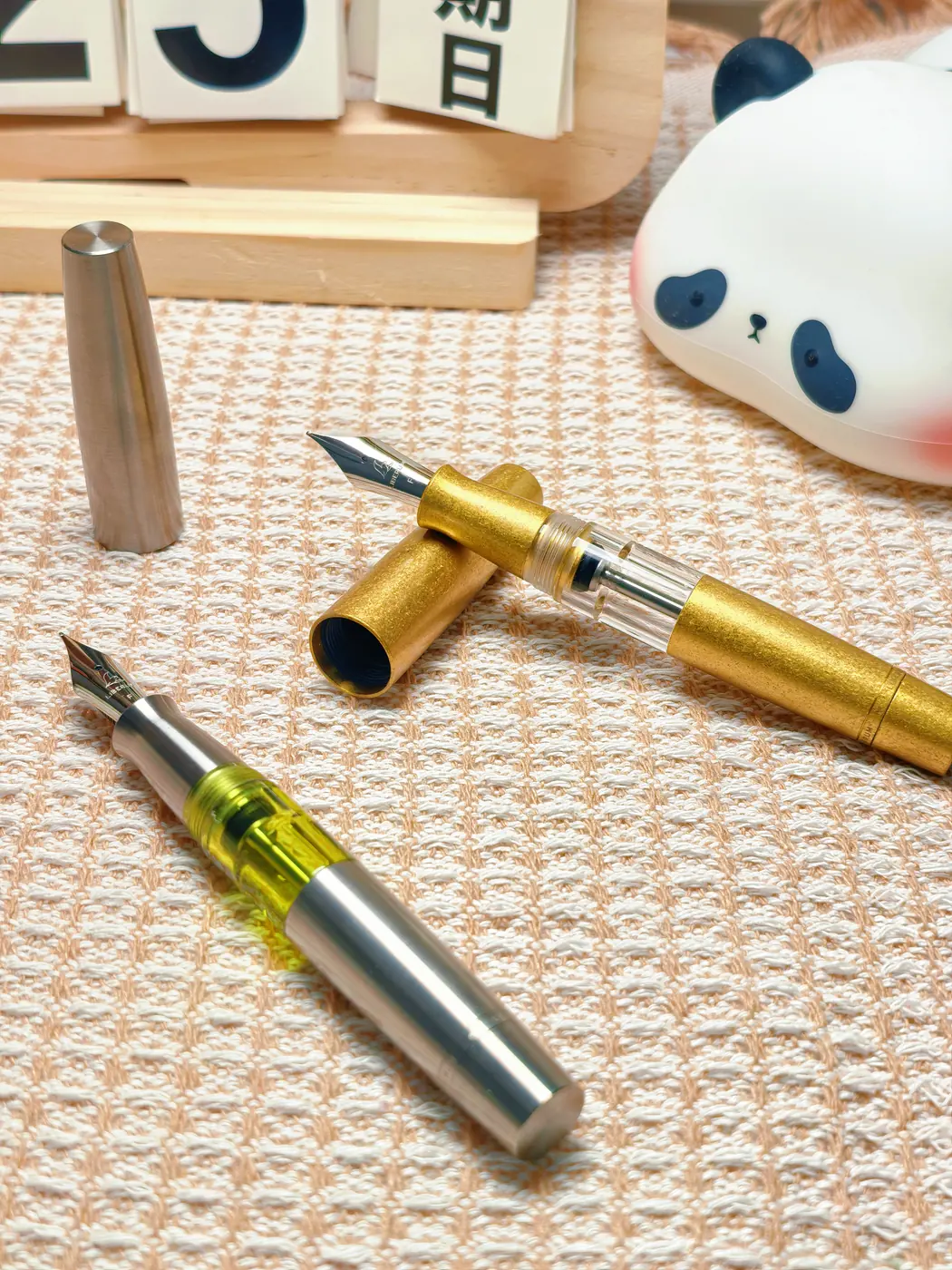
Capped at 120 mm and uncapped: the same body in titanium and brass, with green and clear ink windows.
Decide which tier you need before you read the reviews. The best pen in one tier is not the best in another.
How we compared
Five questions, in this order:
- Does it write well without adjustment? A pen that needs tuning out of the box is a project, not a recommendation.
- How much ink does it hold? Cartridges are convenient and small. Vacuum fillers hold more and need a bottle.
- Does it survive a pocket? Cap security, finish durability, and whether it leaks when warm.
- Can you service it? Standard nibs and standard threads matter more than most reviews admit.
- Is it worth the price? Not "is it cheap" — "is it worth what it costs."
The specifications and prices below come from the manufacturers. The judgments are ours.
1. Kaweco Sport — the default
~$30 plastic / ~$100 brass | 105 mm | cartridge or short converter | small steel nib
The Sport is why most people own a pocket fountain pen at all. It has been in production in roughly this form since the 1930s, it takes short international cartridges, and every stationery shop on earth stocks those cartridges.
What's good: price, availability, weight (the plastic version is almost nothing), and the fact that it is easy to replace if you lose it.
What's not: the nib is small and stiff, and the plastic version feels like what it costs. The cap is a push-fit on some models, which is fine in a pocket and less fine loose in a bag. The brass version solves the feel problem and creates a weight problem — it is heavy for its size.
Buy it if you want a first pocket pen, or a pen you will not mourn if you lose it.
2. TWSBI Vac Mini — the affordable vacuum filler
~$65 | 125 mm | vacuum filler | steel nib
The Vac Mini is the pen that made vacuum filling affordable. Pull the rod, the barrel fills, and you get a much larger ink supply than a cartridge. The demonstrator body lets you watch the mechanism work.
What's good: ink capacity, the filling mechanism, and the price. Nothing else at $65 holds this much ink in a body this small.
What's not: it is plastic, and it looks it. The cap takes several turns. The nib is small and inconsistent between units — some are excellent, some need a look. TWSBI's quality control has improved, but this is still a pen you might have to adjust.
Buy it if you want maximum ink for minimum money and do not care about materials.
3. Liberum Volucris Titanium — the metal vacuum filler
$130 | 120 mm | vacuum filler | #6 steel nib, JoWo-compatible | 41.5 g capped / 28.4 g uncapped
This is the pen we make, so read this section with that in mind. It is here because it occupies a position none of the others do: a metal body, vacuum filling and a pocket-sized length.
The Volucris puts a vacuum filler into a 120 mm body. That is the hard part. The rod needs length, which is why most vacuum fillers are 145 mm or more. The result sits between the true pocket pens and the full-size ones: short enough for a shirt pocket, long enough that your hand is not cramped.
What's good: the only all-metal vacuum filler here. A window in the barrel shows the ink level. The nib is a #6 on a JoWo-compatible housing, so it can be swapped. At 41.5 g capped, it is light enough to forget and heavy enough to feel deliberate.
What's not: 120 mm is not as small as the Schon or the ensso. If you want a pen that disappears into a coin pocket, this is not it. At $130 it costs twice what the Vac Mini does, and the brass version is 66 g — a lot for a pen this size.
Buy it if you want vacuum filling in a metal body, or a #6 nib in a pocket pen without paying $165.
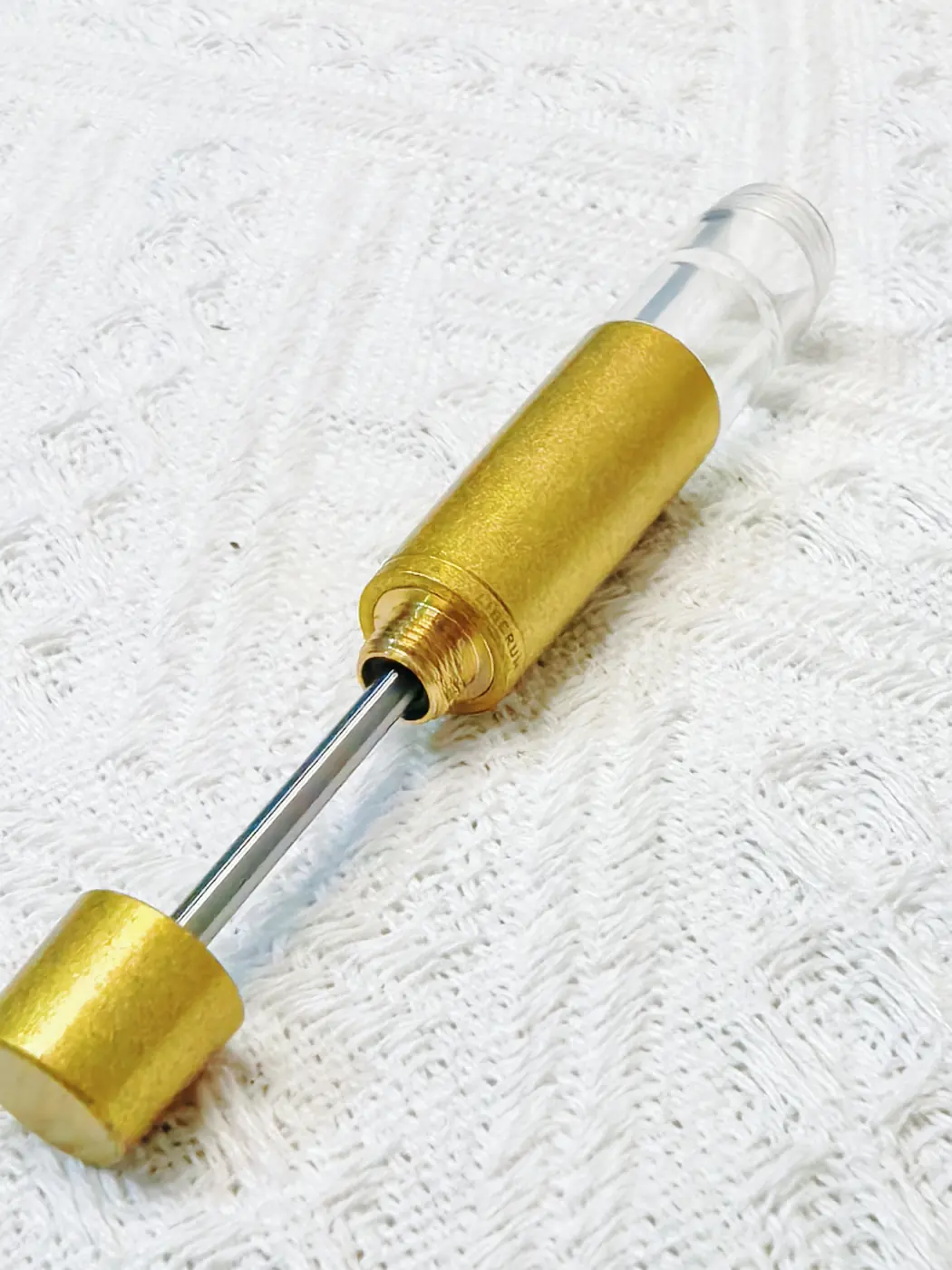
The vacuum rod extends from the back of the barrel. One stroke fills it from the bottle.
4. Liberum Volucris Brass — the same pen with weight
$130 | 120 mm | vacuum filler | #6 steel nib, JoWo-compatible | 66 g capped / 42 g uncapped
The brass version is not a different pen so much as a different decision. It has the same length, nib and filling system, and it costs the same. What changes is 24.5 g of extra metal and a surface that will darken with use.
What's good: the weight makes the pen feel more deliberate, and the patina gives it a character the titanium version cannot match. The clear ink window lets the brass be the only colour on the pen.
What's not: 66 g is heavy for a 120 mm pen, and 42 g uncapped is still a lot to hold for a long session. The patina is not optional. If you want the pen to look the same in five years, choose titanium.
Buy it if you already know you like a heavy pen, or you want a pocket pen that feels like an object rather than a tool.
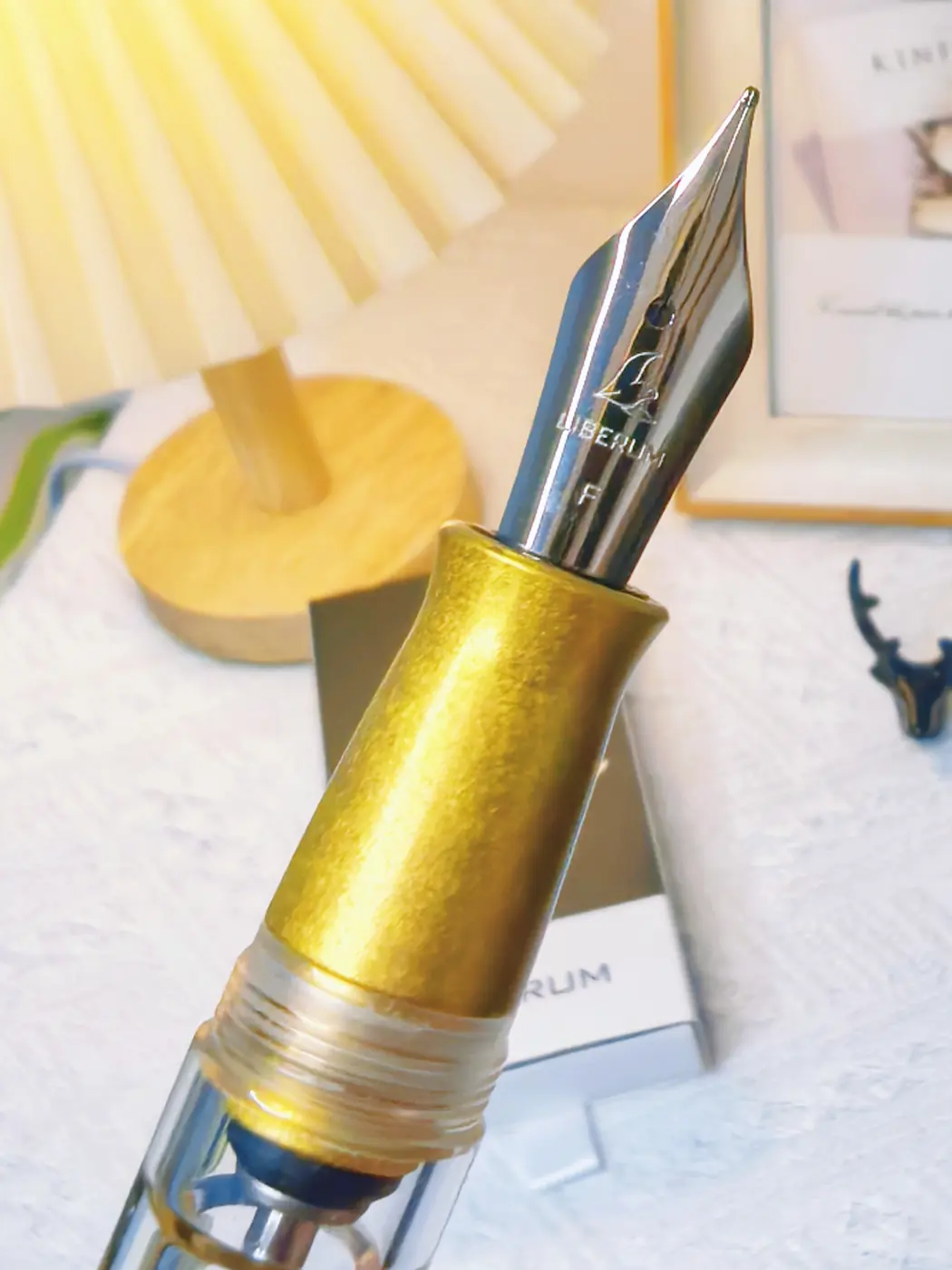
Brass version: clear ink window, #6 steel nib, 66 g capped.
5. Schon DSGN Pocket Six — the shortest serious pen
~$165 | 90 mm capped / 132 mm posted | cartridge or converter | #6 steel nib
Ninety millimetres capped is genuinely small, and the Pocket Six is the only pen here that combines that size with a full #6 nib. It is machined in Philadelphia and built to tighter tolerances than anything else on this list.
What's good: size, machining, and the #6 nib at 90 mm. It posts to 132 mm, which makes it a real writing instrument rather than a novelty.
What's not: the price. $165 for a cartridge pen is a lot, and the custom Monoc nib option pushes it far higher. The metal versions are also dense for their size — heavy, not light.
Buy it if pocketability is the priority and budget is not.
6. ensso PIUMA Pocket — the minimalist
~$139–$172 | 92 mm closed / 140 mm posted | cartridge, converter or eyedropper | steel nib | 38 g
The PIUMA Pocket is a machined titanium tube with almost no decoration. It closes to 92 mm, posts to 140 mm, and weighs 38 g. It can run on cartridges, a converter, or as an eyedropper if you seal the threads.
What's good: materials, weight, and the eyedropper option, which gives it a large ink capacity without a vacuum mechanism. The design is quiet in a way that ages well.
What's not: the same price criticism as the Schon, and the minimalism extends to the grip, which some people find slippery. Eyedropper filling is messy the first three times.
Buy it if you want a titanium pocket pen and prefer cartridges to mechanisms.
The comparison table
| Pen | Price | Capped | Weight | Filling | Body | Nib |
|---|---|---|---|---|---|---|
| Kaweco Sport | ~$30 | 105 mm | light | Cartridge | Plastic | Small steel |
| TWSBI Vac Mini | ~$65 | 125 mm | ~20 g | Vacuum | Plastic | Small steel |
| Liberum Volucris Titanium | $130 | 120 mm | 41.5 g | Vacuum | Titanium | #6 steel |
| Liberum Volucris Brass | $130 | 120 mm | 66 g | Vacuum | Brass | #6 steel |
| Schon Pocket Six | ~$165 | 90 mm | varies | Cartridge | Metal | #6 steel |
| ensso PIUMA Pocket | ~$139–172 | 92 mm | 38 g | Cartridge/eyedropper | Titanium | Steel |
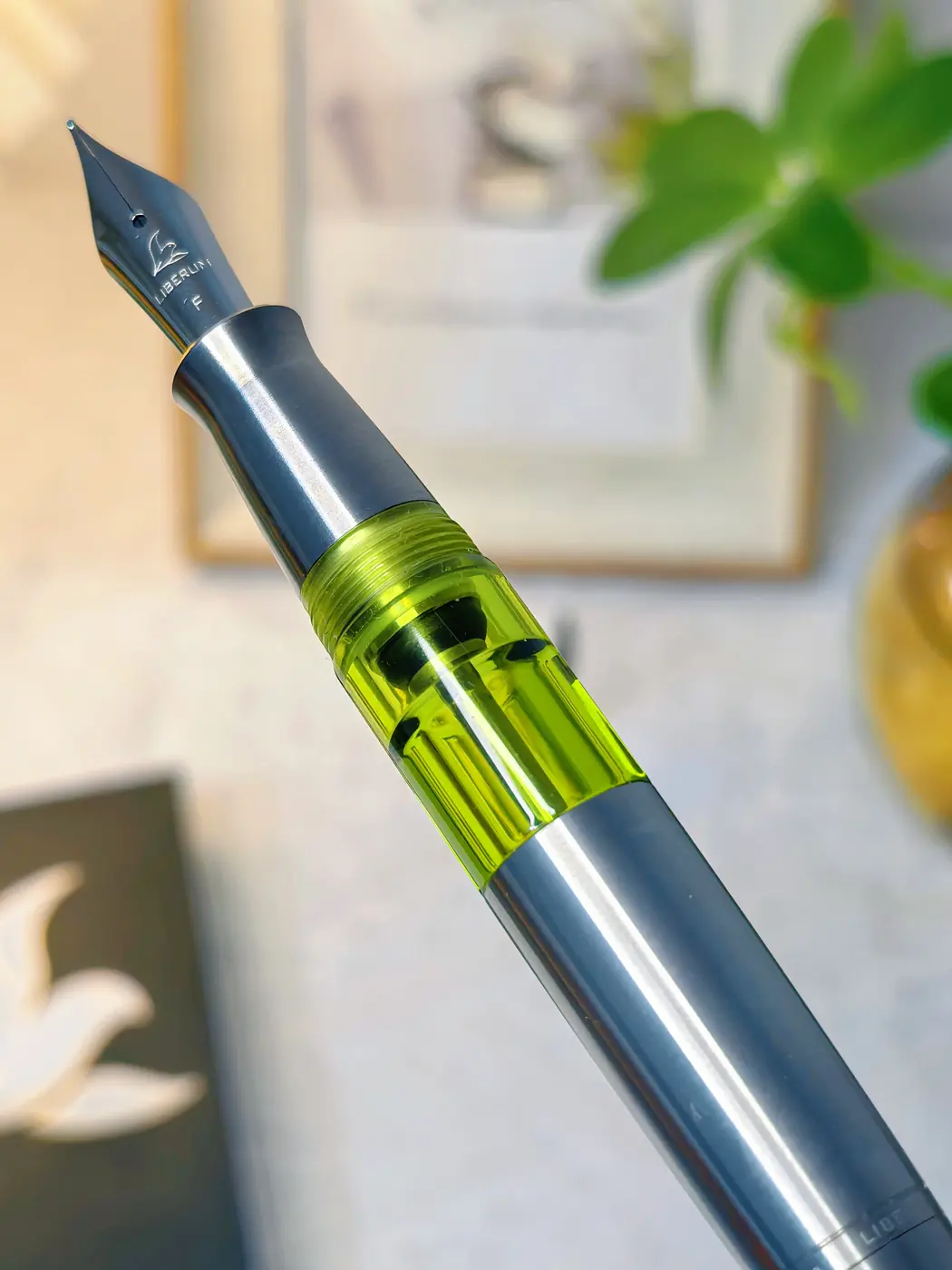
Titanium version, 41.5 g, with the green ink window.
Which one to buy
The smallest pen that still writes properly: Schon Pocket Six.
The most ink for the least money: TWSBI Vac Mini.
The best all-rounder under $100: TWSBI Vac Mini.
The one to carry every day for years: Liberum Volucris Titanium.
The one that feels like an object: Liberum Volucris Brass or ensso PIUMA Pocket.
The one to give someone as a first pocket pen: Kaweco Sport.
What we left out
Vintage pocket pens. Wonderful, and a terrible recommendation for a first purchase. Parts availability and nib condition vary too much.
"Tactical" pens with fountain sections. They are usually ballpoint designs with a nib bolted on, and the ergonomics show it.
Anything over 150 mm. At that point you are carrying a full-size pen and calling it pocket-sized, which is what most "best EDC pen" lists do.
FAQ
Are pocket fountain pens comfortable to write with?
Below 100 mm, most people need to post the cap to get a usable length. Between 115 and 125 mm, most people do not. That is the main practical argument for the 120 mm size.
Do they leak?
A well-made pocket pen with a secure cap does not leak in normal carry. Heat and altitude are the two things that cause problems, so keep it nib-up and fill or empty before flying.
Cartridge or vacuum filler?
Cartridges are cleaner and easier to find. Vacuum fillers hold more ink and cost less per fill. If you write more than a page a day, vacuum wins.
Is titanium worth it over plastic?
For durability and feel, yes. For weight, not necessarily — titanium is lighter than brass but heavier than plastic, and 41.5 g is not a featherweight.
Sources and next steps
- Kaweco Classic Sport series
- TWSBI Vac Mini official product page
- Schon DSGN aluminium Pocket Six specifications
- ensso PIUMA Pocket Titanium specifications
- Compare Liberum pocket fountain pens
- Explore Liberum vacuum fillers
Disclosure: Liberum makes the Volucris, so we have a stake in this comparison. Specifications and prices for the other pens come from the manufacturers linked above. We have used the Volucris; we have not laboratory-tested the competitors.